
Canton Fair is one of the easiest places to meet many bathtub suppliers in a short period of time.
But for importers and bathroom brands, the real challenge is not finding more suppliers. It is identifying which suppliers can actually support a stable, scalable supply chain after the show.
A booth can look professional. Samples can look good. Prices can also be attractive.
None of these automatically tells you whether the factory can maintain quality when order volume increases, deliver during peak season, or support your business when the market changes.
That is why buyer conversations at Canton Fair 2026 should go beyond product style and quotation.
Here are seven supply chain questions worth asking.
Quick Answer
When meeting bathtub suppliers at Canton Fair 2026, buyers should focus on seven areas:
- Available production capacity
- Peak-season lead time
- In-house manufacturing capability
- Batch consistency
- Small-scale trial cooperation
- Product transfer and OEM/ODM capability
- Backup capacity when supply conditions change
These questions help buyers understand whether a supplier is simply able to produce a bathtub—or can become a reliable part of a long-term supply chain.

How Much Production Capacity Is Actually Available for New Orders?
Many suppliers will tell buyers their total monthly capacity.
But total capacity is not the same as available capacity.
A factory may be capable of producing thousands of bathtubs per month, while a large percentage of that capacity is already committed to existing customers.
For buyers, the more useful question is:
How much capacity can actually be allocated to our orders during normal and peak periods?
This becomes especially important for larger programs.
If your business grows from one container per month to several containers, can the supplier increase production without creating quality or lead-time problems?
Buyers should also understand where the real production bottleneck is. It may not be thermoforming. Reinforcement, finishing, assembly, inspection, or packaging can become the slower process when volume increases.
A reliable supplier should understand its actual capacity—not simply quote the maximum theoretical output of the factory.
What Happens to Your Lead Time During Peak Season?
Normal lead time does not always represent peak-season performance.
A supplier that normally delivers within a reasonable production window may require significantly more time when factory schedules become full.
That is why buyers should ask how lead time changes during busy periods and how production priority is managed.
The important thing is not to receive an unrealistically short answer.
It is to understand whether the supplier has a clear planning system.
For example, does the factory reserve production windows for repeat customers? Are raw materials prepared in advance? How early should buyers confirm orders before peak season?
These answers help importers decide when purchase orders should be placed and how much inventory buffer may be needed.
For more on this topic, see How to Reduce Bathtub Supply Chain Risk During Peak Season.
Which Bathtub Manufacturing Processes Are Completed In-House?
This question helps buyers understand how much control the supplier actually has over production.
For acrylic bathtubs, important processes may include thermoforming, CNC cutting, drilling, reinforcement, structural assembly, surface finishing, quality inspection, and packaging.
A supplier that relies heavily on outside subcontractors may still produce good products, but the buyer should understand where production control ends.
This matters because external processing can affect:
- Lead time
- Quality consistency
- Capacity planning
- Problem solving
- Production visibility
The objective is not necessarily to find a factory that completes absolutely everything in-house.
The objective is to understand who controls the critical processes and how quality is managed across the production chain.
For an OEM/ODM acrylic bathtub program, this becomes especially important because customized products may require closer coordination between development and production.
How Do You Maintain Quality When Order Volume Increases?
A good sample is important.
But for B2B buyers, repeat-order consistency is usually more important.
One of the most useful questions at Canton Fair is:
How do you make sure the 500th bathtub matches the approved sample?
This can reveal much more than simply asking whether the factory has quality control.
Buyers should listen for details about material control, process standards, inspection points, dimensional checks, reinforcement, surface inspection, and final packaging.
The concern is especially relevant when production volume increases quickly.
A factory may perform well with a small order but face more variation when the production line becomes busy.
The supplier should be able to explain how it controls consistency across different workers, batches, and production periods.
If the answer stays very general, buyers may need to investigate further after the show.
Can We Start With a Few SKUs Before Expanding the Program?
This is one of the most practical questions for buyers building a new supply source.
You do not need to move an entire bathtub collection to a new supplier immediately.
A much safer approach is to begin with a few representative SKUs.
For example, a buyer may start with one high-volume freestanding bathtub and one standard alcove or skirted model.
The first orders can then be used to evaluate:
- Product quality
- Production consistency
- Lead time
- Packaging
- Communication
- Container loading
If the supplier performs well, additional SKUs or higher order volume can be introduced later.
This is particularly useful for companies looking for a bathtub factory outside of China.
Instead of making a large sourcing shift immediately, buyers can first build and validate the alternative source with controlled risk.
You can also read China + 1 Strategy for Bathtub Sourcing: Is Vietnam the Right Second Source?.
What Is Required to Reproduce or Develop Our Existing Bathtub Models?
For buyers considering an alternative supplier, this is a critical question.
Switching production is not as simple as sending a product photo.
The supplier may need technical drawings, dimensions, material specifications, drain positions, surface requirements, packaging standards, and mold information.
For custom programs, buyers should also understand the supplier’s OEM/ODM process.
Important questions include:
| Area | What Buyers Should Confirm |
|---|---|
| Existing model | What information is required to reproduce it? |
| Mold | Can an existing mold be used or is a new mold required? |
| Dimensions | What tolerances can the factory control? |
| Drain position | Can the required layout be reproduced? |
| Finish | Are matte and glossy options available? |
| Packaging | Can current export packaging be matched or improved? |
| Private label | Can branding and labeling requirements be supported? |
A strong OEM/ODM acrylic bathtub supplier should be able to explain the development process clearly instead of simply saying, “Yes, we can customize.”
If Our Current Supplier Has a Problem, How Quickly Can You Support Additional Volume?
This question goes directly to supply-chain resilience.
A second supplier only creates value if it can take meaningful production volume when needed.
Buyers should ask how much additional capacity the supplier could realistically provide and what preparation would be required before increasing orders.
The answer may depend on:
- Mold availability
- Raw-material planning
- Production schedule
- Packaging preparation
- Labor
- Existing customer commitments
If the supplier has already produced and approved several of your SKUs, increasing volume can be much easier than starting from zero.
This is why supplier qualification should happen before a disruption occurs.
A backup supplier is much more useful when it is already tested.
For a broader framework, see How to Build a Resilient Bathtub Supply Chain for U.S. Importers.
A Simple Supplier Evaluation Table for Canton Fair
After several days at Canton Fair, supplier information can become difficult to compare.
A simple scorecard can help buyers organize the most important supply-chain factors.
| Area | What to Record |
|---|---|
| Product specialization | How focused is the supplier on acrylic bathtubs? |
| Available capacity | Real capacity for new orders |
| Peak-season lead time | Normal vs. busy-period lead time |
| Quality control | How consistency is maintained |
| OEM/ODM | Ability to reproduce or develop products |
| Mold options | Existing and custom mold capability |
| Packaging | Export packaging experience |
| Trial cooperation | Willingness to start with a few SKUs |
| Scale-up | Ability to support higher future volume |
| Communication | Clarity and responsiveness |
The objective is not to select a supplier directly at the booth.
It is to identify which suppliers deserve the next stage of qualification.
Meet Salvere at Canton Fair 2026
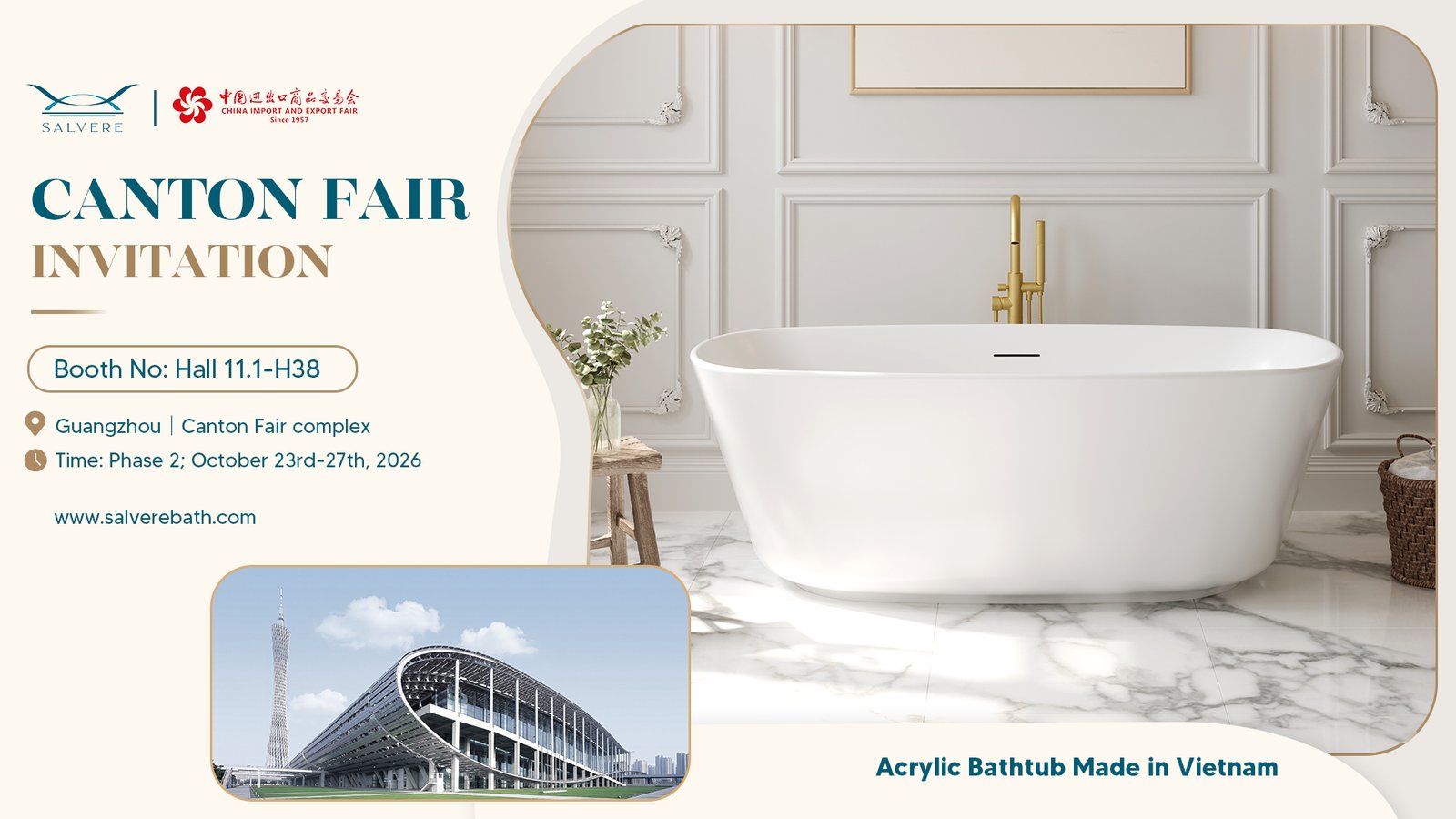
For buyers looking for an OEM/ODM acrylic bathtub supplier or a bathtub factory outside of China, Salvere will exhibit at Canton Fair 2026 Phase 2.
Salvere manufactures acrylic bathtubs in Vietnam and focuses on freestanding, alcove, corner, skirted, and other acrylic bathtub structures.
Buyers can discuss existing molds, custom development, selected-SKU trial programs, packaging, production capacity, and how Vietnam can fit into an existing China + 1 or multi-country sourcing strategy.
You do not need to move an entire bathtub program at once.
A practical starting point can be several selected SKUs, allowing your team to evaluate Salvere’s quality, lead time, packaging, communication, and production consistency through actual orders before expanding the cooperation.
Canton Fair 2026 – Phase 2
October 23–27, 2026
Canton Fair Complex, Guangzhou
Salvere Booth: Hall 11.1 – H38
Learn more about Salvere’s OEM/ODM Acrylic Bathtub Solutions.
Conclusion
Canton Fair can introduce buyers to hundreds of suppliers.
But the most valuable supplier is not necessarily the one with the largest booth, the widest product range, or the lowest quotation.
For bathtub importers, the more important question is:
Can this supplier become a reliable part of our supply chain when volume grows or market conditions change?
Ask about real capacity, peak-season performance, manufacturing control, batch consistency, OEM/ODM capability, trial cooperation, and scale-up flexibility.
The goal is not to leave Canton Fair with more business cards.
It is to leave with a smaller number of suppliers that are worth qualifying.
FAQ
What should bathtub buyers ask suppliers at Canton Fair?
Buyers should ask about available capacity, peak-season lead time, manufacturing processes, quality consistency, OEM/ODM capability, trial orders, and the supplier’s ability to support higher future volume.
Is factory capacity more important than product variety?
Both matter, but buyers planning long-term orders should understand whether the factory can consistently produce the required products at the expected volume.
Should buyers start with a trial order after Canton Fair?
For a new supplier, starting with several selected SKUs and a controlled trial order can reduce sourcing risk before larger volume is committed.
What should buyers look for in an OEM/ODM acrylic bathtub supplier?
Look at product specialization, development capability, mold options, production consistency, packaging, capacity, lead time, and communication.
Why look for a bathtub factory outside of China at Canton Fair?
An additional manufacturing country can help reduce sourcing concentration and provide more flexibility when tariffs, capacity, or other supply conditions change.


